Luna van Son on the effect of rising temperatures on children’s nutritional status in India
This study investigates the effect of rising temperatures on children's nutritional status in India by using the binned temperature approach in combination with recent district-level data of health and daily temperatures. This information is useful for policymakers to assess whether the increasing temperatures and the prevalence of child malnutrition in this developing country are related. Additionally, the findings of this study help in achieving the second and third Sustainable Development Goals: Zero Hunger (2) and Good Health and Well-Being (3).
"Due to physiological, metabolic and behavioral characteristics, children are more sensitive to hot and cold temperatures than adults."
Impact of ambient temperature on children’s health: A systematic review

Data and methodology
To analyze this effect, district-level data on children’s1 health (i.e. Weight-for-Age Z-scores2) from the two most recent waves of the National Family Health Survey (i.e. NFHS-4 and NFHS-5) are used in combination with weather data (e.g. daily temperatures) from 467 Indian districts in total.
The binned temperature approach groups the daily average temperatures measured in degrees Celsius of all the 467 Indian districts into six bins (𝑛) with a width of 4°C each, see Figure 2. This approach enables combining the high frequency weather data (i.e. daily temperatures) with the wave-level aggregated health data from NFHS-4 and NFHS-5.
[1] Children are defined as children under 5 years old / 0-59 months.
[2] WAZ scores can range from -6 to 6, and indicate how many standard deviations (SD) a child’s weight deviates from the median weight of a reference population with the same age and sex.
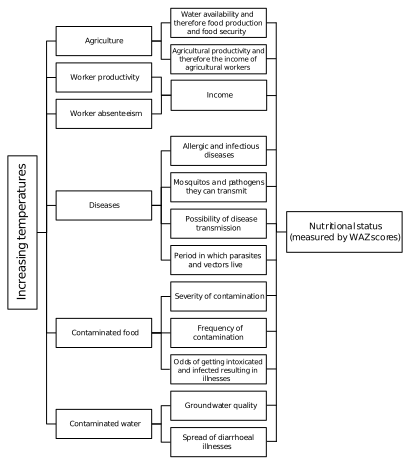
Figure 1 on the right indicates how, according to existing literature, increasing temperatures influence (children's) health and nutritional status negatively through multiple channels: agriculture, income, worker productivity, worker absenteeism, diseases, and contamination of both food and water.
The height of the bars in Figure 2 on the left reflects the number of days averaged across the 467 Indian districts and the two waves (i.e. 2015-2016 and 2019-2021) with a daily average temperature that falls within one of the six bins. Temperature bin 4 (24-28°C) has the highest bar, which indicates that the most common temperatures observed in the 467 districts are between 24-28°C.
Concluding remarks
Further research should be done using a household sample with a larger number of observations that covers more than two waves, to investigate whether the limitations of this study are the reason no statistically significant effect was found between rising temperatures and children’s nutritional status in India.